Vairocana (Vairochana) Buddha Thangka: Meaning and a Buyer’s Guide
Vairocana and Vairochana are two English spellings an overseas buyer may encounter for the same broad Buddha subject. The familiar name does not settle every question about a particular image: museum records show different forms, gestures, media, and cultural settings. This guide separates subject background from the verified facts attached to one contemporary miniature card.
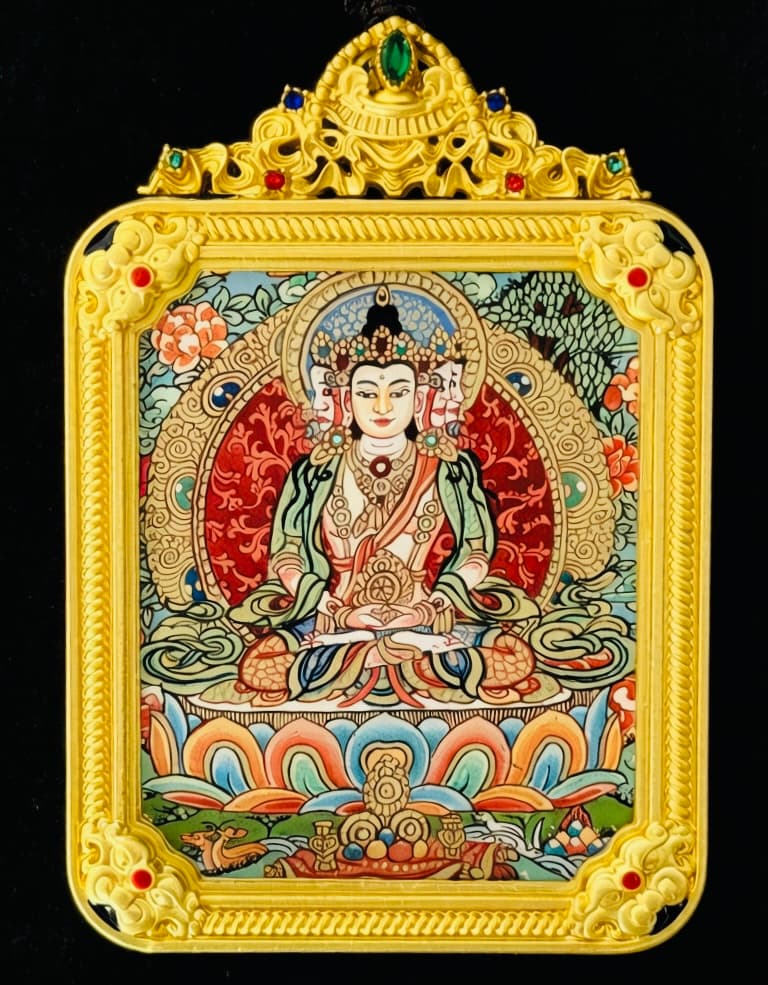
Who is Vairocana in Buddhist art?
Museum resources commonly describe Vairocana as a celestial, transcendent, universal, or cosmic Buddha. The Metropolitan Museum of Art identifies an early eighth-century Chinese sculpture as Vairocana and places him at the center of the cosmos. The British Museum authority record likewise connects Vairocana with the center of the mandala in esoteric Buddhist contexts.
Project Himalayan Art gives a specifically Tibetan Buddhist example. Its essay on the Sarvavid Vairochana Visualization Album connects Vairochana with Buddha Shakyamuni’s awakening and a Buddhist universe while explicitly noting that Vairochana has several forms. These sources establish context, not one compulsory image.
Vairocana, Vairochana, and the Mahavairocana boundary
Vairocana and Vairochana are common English romanizations of the same name, and major museums use both spellings. The Met titles one Chinese sculpture Seated Buddha Vairocana, while the British Museum titles a Dunhuang painting Vairochana with the Eight Great Bodhisattvas. A buyer searching either spelling is therefore looking within the same broad subject area.
Mahavairocana requires more care. The term appears in museum records for particular doctrinal and regional forms, including the Met’s Dainichi, the Cosmic Buddha (Mahavairocana). That record explains why related names appear near one another in search results, but it does not authorize a seller to add every related term to every product. The current store record uses Vairocana, with Vairochana as a search spelling; it does not use Mahavairocana as the object name.
Why Vairocana images do not all look the same
A quick image search can make one hand gesture, color, crown, or posture seem decisive. Museum records show why that is too simple. The Met’s early eighth-century seated Vairocana uses a teaching gesture, while a different Met Buddha Vairocana uses a wisdom-fist gesture and is discussed in a mandala setting. Project Himalayan Art presents Sarvavid Vairochana through a visualization album shaped by Tibetan Buddhist content, Mongolian patronage, and Chinese court style.
The British Museum’s Dunhuang painting places a central Vairochana with the Eight Great Bodhisattvas in a large composition. These examples show that a Vairocana label does not by itself prove a fixed gesture, region, lineage, mandala, or ritual system. A narrower identification should be supported by the complete image and object record rather than one familiar feature.
How to read a Vairocana thangka carefully
Begin with the whole image. Ask whether one Buddha is central or whether the work belongs to a larger assembly; observe the hands, posture, seat, crown or robes, halo, surrounding figures, and any legible inscription. Then separate subject from physical format: a scroll, framed painting, miniature card, pendant-style work, and sculpture are different objects even when they share a name.
Use museum examples for comparison, not as a universal checklist. A gesture documented for one sculpture does not automatically identify a miniature painting, and color alone cannot establish the exact form. Combine the complete composition, visible attributes, reliable inscriptions where present, and the item-level record.
What changes at 5 × 4 cm?
A miniature can look much larger on a screen than it is in the hand. At 5 × 4 cm, exact dimensions and a full-object photograph are important for judging how the face, hands, outlines, edges, and complete composition read at actual scale. Format wording matters too: a miniature card is not automatically a pendant, necklace, framed work, or mounted scroll.
Small scale does not prove difficulty, rarity, age, value, or technique, and price cannot substitute for evidence. Connect the title, real photograph, dimensions, price, availability, and stable record reference to the same object. Use the product page for the live transaction details and the educational guide for subject context.
The current RT-2026-007 Vairocana miniature
RT-2026-007 is recorded as a hand-painted Vairocana miniature thangka card. Its recorded size is 5 × 4 cm, its recorded origin is China, and its current listed price is US$4,150. The product page shows the current object through its real photograph and individual artwork record.
The museum works discussed in this guide are educational comparisons only and do not serve as item-level evidence for RT-2026-007. Availability, price, shipping, returns, and the latest object wording remain on the live product page.
A practical checklist before buying
First confirm that the product photograph shows the offered object. Check that title, subject, 5 × 4 cm dimensions, miniature-card format, price, availability, and RT-2026-007 reference appear together. Treat Vairocana and Vairochana as compatible search spellings, but ask what evidence supports any more specific form, mandala, lineage, or ritual classification.
Then review the transaction separately from the cultural story. Read the live shipping quote, dispatch expectations, destination duties, returns policy, and support channel. An educational page can explain Vairocana’s place in Buddhist art without promising awakening, protection, healing, wealth, luck, merit, investment value, or another personal result.
Frequently asked questions
Are Vairocana and Vairochana the same Buddha name? They are common English romanizations used for the same broad Buddha subject. A stable product title may choose one spelling and mention the other for search clarity.
Is Mahavairocana automatically the full name of every Vairocana image? No. Mahavairocana appears in museum records for particular forms and traditions. It belongs in related background unless an individual object record supports the narrower name.
Is there one hand gesture that identifies every Vairocana? No. Museum-identified examples use more than one gesture, and Project Himalayan Art explicitly notes several forms. Read the complete composition rather than turning one feature into a universal rule.
What should I check in a miniature thangka card? Confirm the actual 5 × 4 cm scale, full-object photograph, format, title, price, availability, record number, shipping, returns, and support route.
Does owning a Vairocana thangka guarantee spiritual benefit? No seller can responsibly guarantee a religious, medical, financial, or practical outcome. Cultural meaning can be discussed respectfully without becoming a sales promise.
A clear way to decide
Start with the paired names, then inspect the complete image, physical format, dimensions, and item record while keeping museum context separate from the actual object’s evidence. A respected subject name is not a shortcut around object-level facts.
For RT-2026-007, the purchase facts are deliberately narrow: a hand-painted Vairocana miniature thangka card, 5 × 4 cm, China, US$4,150, record RT-2026-007, and a real product photograph. Decide from those facts, the live order terms, and any additional view you choose to request—not an invented story or promised outcome.
Continue with a related guide
Compare subject, scale, format, photographs, records, shipping, and returns before deciding.
How to read a thangka artwork recordUnderstand record numbers, subject names, measurements, photographs, source notes, provenance, and certificates.
Miniature thangka buyer’s guideA practical guide to small scale, image detail, physical format, shipping, and international purchase checks.
Browse available worksSee the current hand-painted thangkas and miniature works with real photographs and individual records.
International shippingRead how checkout rates, dispatch, customs, duties, and destination charges are handled.
Sources and further reading
- Seated Buddha Vairocana — object 43.24.3 · The Metropolitan Museum of Art
- Vairocana authority record · The British Museum
- The All-Knowing Buddha Vairochana Visualization Album · Project Himalayan Art / Rubin Museum
- Vairochana with the Eight Great Bodhisattvas — object 1919,0101,0.50 · The British Museum
- Dainichi, the Cosmic Buddha (Mahavairocana) — object 26.118a, b · The Metropolitan Museum of Art
- Buddha Vairocana (Dari) — object 2006.284 · The Metropolitan Museum of Art
From the guide to a specific work
View the Vairocana miniature described in this guide
The current first batch contains one direct Vairocana subject match. Use the live listing for the object facts and this guide for names, visual variation, scale, and buyer checks.
Vairocana Miniature Thangka Card
Vairocana Miniature Thangka Card
$4,150.00
Why it relates to this guide
A hand-painted 5 × 4 cm Vairocana (Vairochana) miniature thangka card from China, listed at US$4,150 under record RT-2026-007.
Browse available works
View current works, dimensions, materials, and prices.