Yellow Jambhala Thangka Meaning: A Careful Buyer’s Guide
Yellow Jambhala is commonly described as a wealth deity in Buddhist art, but that cultural association is not a promise of money or good fortune. This guide separates the subject’s visual context from sales claims and shows what an overseas buyer can verify in a contemporary miniature.
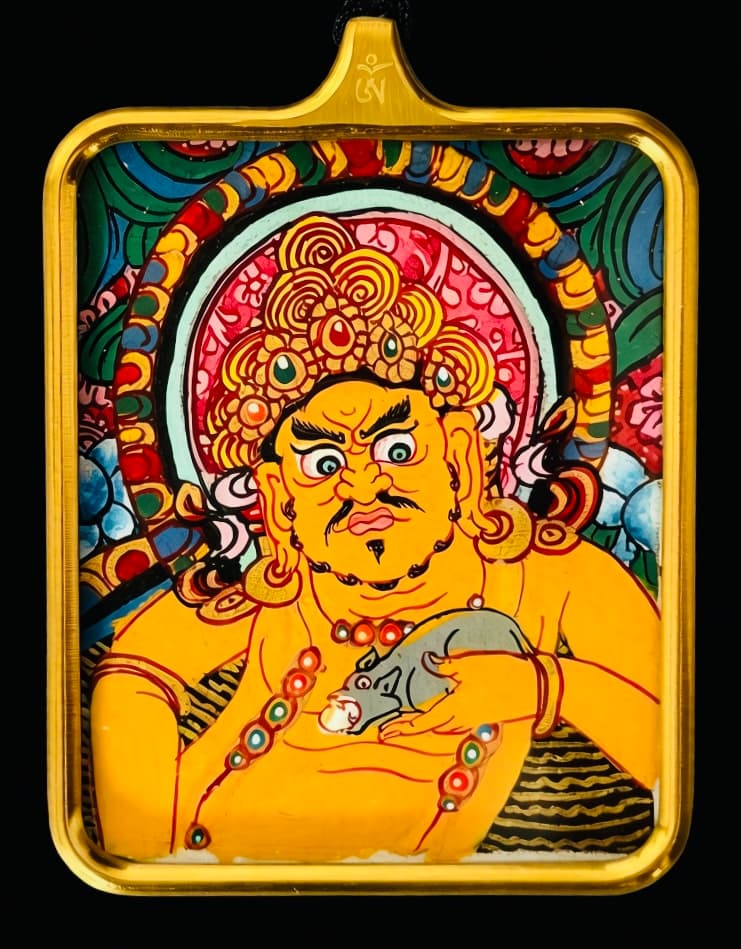
What Yellow Jambhala means in Buddhist art
Jambhala appears in several forms across Himalayan Buddhist art. Yellow Jambhala is one of the best-known forms and is associated in traditional sources with wealth and abundance. That association belongs to a religious and cultural context; it should not be rewritten as a guarantee that owning an image will improve a buyer’s finances.
Museum and research collections show that Yellow Jambhala does not have one universal appearance. The number of faces and arms, hand attributes, surrounding figures, and lineage context can differ. A responsible listing names only what can be seen or documented in the particular work.
How to look at a Yellow Jambhala image
Begin with the complete figure and overall composition, then inspect the face, hands, attributes, seat, border, and background. A yellow body color can support the identification, but color alone is not enough to determine an exact iconographic form or ritual lineage.
For a miniature, close photography matters more than dramatic wording. Line edges, facial detail, surface condition, and the relationship between the painting and its frame are difficult to judge from a distant photograph. Ask for additional detail or reverse images when the available record does not answer an important question.
What is documented for the current miniature
The available work is recorded as a hand-painted 5 × 4 cm Yellow Jambhala miniature in a pendant-style frame. Its public price is US$350, inventory is one, and the product record is RT-2026-003.
The object is listed as a contemporary hand-painted work made in China. The product page carries the current photographed view, price, dimensions, record reference, shipping information, and availability.
Checklist before an international purchase
Confirm the stated 5 × 4 cm scale, the pendant format, the number of available photographs, and whether you need a reverse or side view. Read the shipping estimate separately from dispatch time, and check the DAP terms: import duties, VAT or GST, customs charges, and carrier fees may be payable by the recipient.
Use the product page for the actual price, availability, image, and record reference. Use this guide only for background. If a detail affects your decision and is not recorded, contact the store before payment rather than treating an educational article as proof about the object.
Frequently asked questions
Does a Yellow Jambhala thangka guarantee wealth? No. It can carry religious, symbolic, and artistic meaning, but a responsible seller should not promise financial results, luck, investment returns, or changes in a buyer’s circumstances.
Is this miniature an antique? No. It is listed as a contemporary hand-painted object, not an antique, cultural relic, temple-sourced object, or work with a documented historical date.
Can I request another photograph before buying? Yes. Contact the store and name the exact view or detail you need to assess.
Sources and further reading
- Jambhala (Buddhist Deity) — Yellow · Himalayan Art Resources
- Jambhala iconographic forms · Himalayan Art Resources
From the guide to a specific work
See the Yellow Jambhala miniature described in this guide
The current first batch contains one direct subject match. Its listing carries the object-specific facts; the guide provides cultural and buying context only.
Yellow Jambhala Miniature Thangka Pendant
Yellow Jambhala Miniature Thangka Pendant
$350.00
Why it relates to this guide
A hand-painted 5 × 4 cm Yellow Jambhala miniature, listed at US$350 with one photographed view and the current documentation limits stated.
Browse available works
View current works, dimensions, materials, and prices.