Who Is Zaki Lhamo? Drashi and Trapchi Names, Iconography, and the Palden Lhamo Question
This store keeps Zaki Lhamo as the stable English name for two current works. Drashi Lhamo and Trapchi Lhamo have stronger specialist or academic support, while Zhaji Lhamo and Zakiram are common modern search spellings with less stable romanization. Palden Lhamo belongs to a related but more complex classification and belief question, so it should not be used as an interchangeable product name.
Why this store uses the name Zaki Lhamo
The two current item records use the Chinese name 扎基拉姆, and Zaki Lhamo is the clearest stable English merchandising form for those records. It is also the spelling many overseas product searches currently use. Keeping one product name prevents a title from becoming a pile of uncertain variants.
A stable listing name does not make every similar spelling an exact synonym. This guide uses separate evidence levels: academic transcription and field research, specialist iconographic classification, contemporary religious usage, and modern commercial search spellings. Readers can find the terms they encounter online without turning them into identical labels.
Trapchi, Drapchi, and the academic record
Daisuke Murakami’s peer-reviewed study The Trapchi Lhamo Cult in Lhasa uses Trapchi Lhamo for the Tibetan name Grwa bzhi lha mo. The study notes that Drapchi is common in written sources while Trapchi better reflects the local pronunciation used in the fieldwork. Digital Himalaya’s journal index identifies the article within Revue d’Études Tibétaines 27.
That makes Trapchi and Drapchi evidence-based scholarly spellings, but they behave differently in search. Drapchi is heavily mixed with prison, film, and political-history results, so it is a poor product-title or URL term. Trapchi belongs in an explanatory guide about the cult, place, and naming history rather than being added mechanically to a product name.
Drashi Lhamo and visible iconographic clues
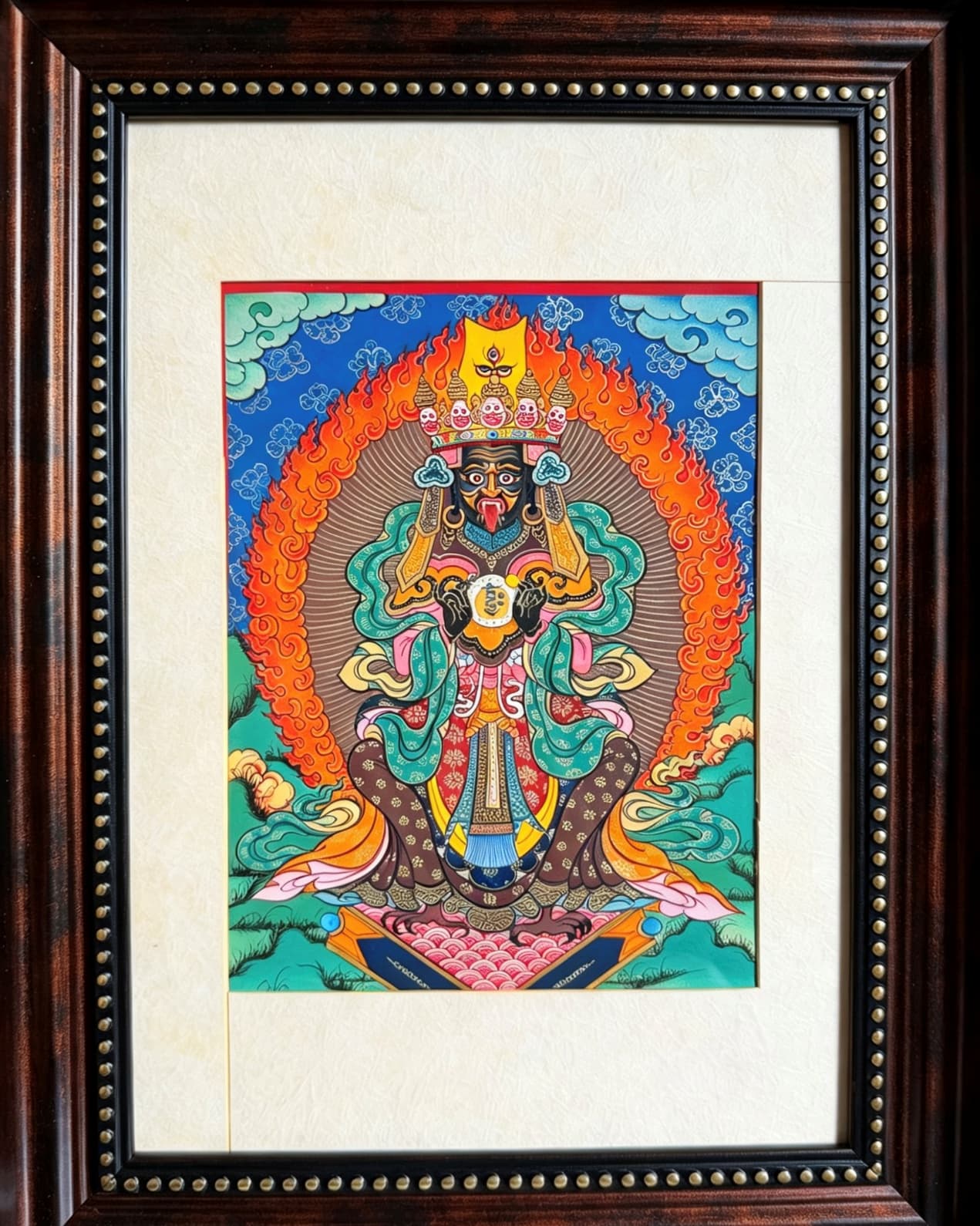
Himalayan Art Resources uses Drashi Lhamo and describes a distinctive appearance that can include three eyes, an extended tongue, an oracle-style crown, a mirror ornament at the chest, and claw-like feet. These features give readers a structured way to compare an image rather than relying on a sales legend or body color alone.
Iconographic comparison can support a subject discussion, but it does not establish the maker, workshop, production date, materials, regional origin, or religious history of a particular object. A narrower classification should remain separate from the item facts shown by a store photograph and record.
Where Zhaji Lhamo and Zakiram fit
Zhaji Lhamo, Zha-ji La-mu, Zakiram, and Zashi Lhamo appear frequently in contemporary websites and commercial search results. A present-day Drashi Lhamo religious website also lists several of these forms. They are useful discovery terms because readers genuinely encounter them, but they are not equally stable or standardized romanizations.
For that reason, this guide can answer searches for Zhaji Lhamo or Zakiram without declaring either the official English name. The product titles remain Zaki Lhamo, while modern variants stay in the explanatory text and FAQ where their source level can be stated honestly.
Is Zaki Lhamo the same as Palden Lhamo?
The safest answer is that sources describe a relationship, but not a simple interchangeable name. Himalayan Art Resources treats Drashi Lhamo within the wider Shri Devi field and separately explains that Shri Devi covers multiple forms rather than one single appearance. Murakami records a belief among some participants that Trapchi Lhamo is a manifestation of Palden Lhamo; a documented belief is not the same as proof that every label names the same iconographic form.
The Metropolitan Museum of Art’s Palden Lhamo painting provides a useful contrast: it shows a classic four-armed, mule-riding form with a different visual expectation from the current Zaki Lhamo works. Palden Lhamo and Shri Devi therefore belong in the relationship discussion, not in the product title, alternate name, or search metadata for RT-2026-001 or RT-2026-009.
Belief context is not a sales guarantee
Murakami’s field research discusses Trapchi Lhamo worship among people including merchants and travelers and records beliefs connected with worldly requests. A Library of Congress oral-history transcript also preserves first-person references to Trapchi Lhamo. These sources describe lived practice and testimony; they do not turn an artwork into a guaranteed financial, health, luck, or protection product.
A responsible listing can explain that such beliefs exist while refusing promises such as attracts money, instant wealth, guaranteed luck, healing, or protection. It should also avoid inventing a mantra, initiation, consecration, ritual teacher, temple history, or devotional instruction for an individual work.
Two current Zaki Lhamo works
RT-2026-001 is recorded as a hand-painted framed Zaki Lhamo thangka with a 15 × 20 cm painting center. Its item-level source note identifies the Rebgong thangka tradition. That regional note belongs to this specific record and should be read beside the actual photograph, framed format, dimensions, price, and current availability.
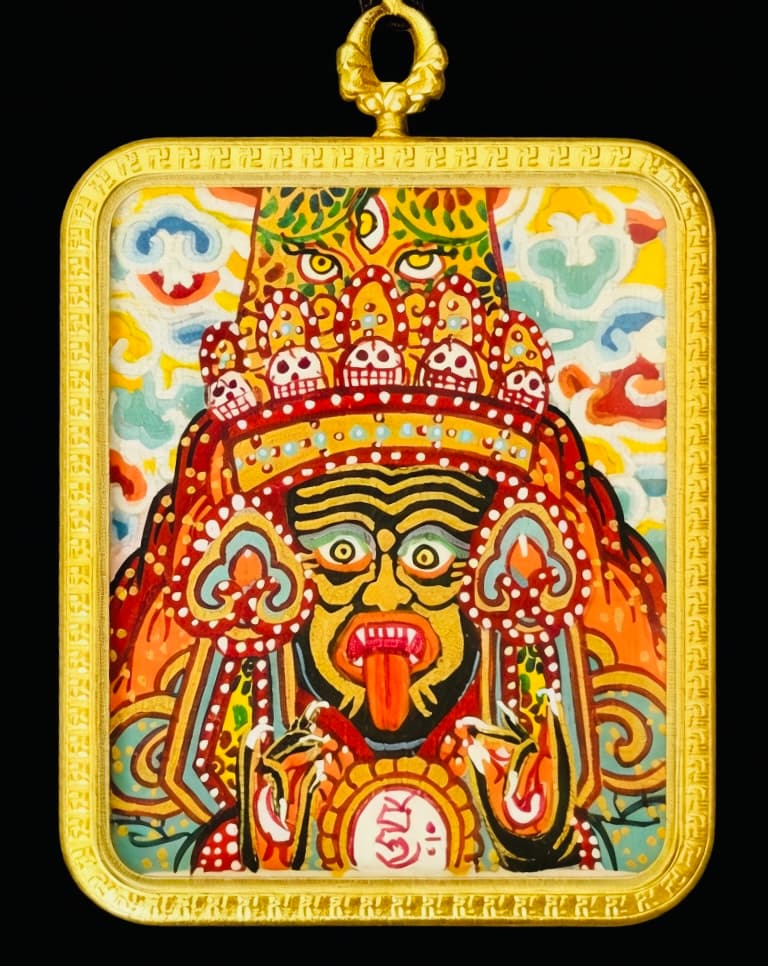
RT-2026-009 is recorded as a hand-painted 5 × 4 cm Zaki Lhamo miniature thangka card. Its format and scale differ from the framed work, and the RT-2026-001 Rebgong statement must not be transferred to it. The live product pages—not general name research—remain the source for each object’s photograph, price, availability, shipping, and item wording.
A buyer checklist for a Zaki Lhamo thangka
Confirm that the photograph shows the actual object, then compare the face, eyes, tongue, crown, chest ornaments, hands, feet, seat, and surrounding composition with the subject name. Check exact dimensions together with format, and distinguish a painting-center measurement from the complete framed object or a miniature card’s outer size.
Use the stable item reference to connect the title, photograph, correspondence, and purchase record. Read the source note only within its stated scope. Then review visible condition, presentation, international shipping, duties, returns, and the support channel before paying. Name research is a tool for better questions, not a substitute for the object record.
Frequently asked questions
Are Zaki Lhamo and Drashi Lhamo exactly the same English name? They are used for closely related subject discussions, but they come through different modern and specialist spelling contexts. This store keeps Zaki Lhamo as the product name and explains Drashi separately.
Are Trapchi Lhamo and Drapchi Lhamo both found in research? Yes. Murakami uses Trapchi for the local pronunciation and notes the more common written Drapchi form. Drapchi is avoided as a search title because it is strongly associated with unrelated prison and political-history results.
Can I search for Zhaji Lhamo or Zakiram? Yes. They are common modern discovery spellings, but this guide does not present them as standardized romanizations or place them in the product titles.
Is Zaki Lhamo simply another name for Palden Lhamo? No. Sources discuss classification and manifestation relationships, while Palden Lhamo also names other well-established forms. The terms should not be swapped on a product listing.
Does buying a Zaki Lhamo image guarantee wealth or luck? No seller can responsibly guarantee financial, medical, spiritual, or practical outcomes from owning an artwork.
A careful naming decision
Use Zaki Lhamo to identify the two current store records. Use Drashi and Trapchi to understand specialist and academic contexts. Treat Zhaji and Zakiram as modern discovery spellings, and keep Palden Lhamo within a clearly qualified relationship discussion.
That approach makes more search terms understandable without sacrificing accuracy. It also keeps the buyer’s attention on the actual object: subject, photograph, format, dimensions, item reference, source note where applicable, shipping, and returns.
Continue with a related guide
Compare subject, scale, format, photographs, records, shipping, and returns before deciding.
How to read a thangka artwork recordUnderstand record numbers, subject names, measurements, photographs, source notes, provenance, and certificates.
Rebgong or Regong?How Rebgong, Regong, Tongren, and Qinghai relate—and why spelling alone is not provenance.
Artwork recordsRead how the store separates item facts, source notes, certificates, and unsupported claims.
Sources and further reading
- The Trapchi Lhamo Cult in Lhasa · Revue d’Études Tibétaines
- Revue d’Études Tibétaines issue index · Digital Himalaya
- Drashi Lhamo · Himalayan Art Resources
- Shri Devi forms · Himalayan Art Resources
- Offerings to the Goddess Palden Lhamo — object 1983.510.1 · The Metropolitan Museum of Art
- Tibetan Oral History Archive transcript OR_0033_01 · Library of Congress
- Drashi Lhamo — contemporary spelling reference · Drashi Lhamo
From the guide to a specific work
Compare the two current Zaki Lhamo works
The store keeps Zaki Lhamo as the stable product name. Use the guide for the evidence levels behind Drashi, Trapchi, Zhaji, and related search spellings, then compare the two objects through their separate item records.
Zaki Lhamo Framed Thangka
Zaki Lhamo Framed Thangka
$5,550.00
Why it relates to this guide
A framed hand-painted Zaki Lhamo thangka with a 15 × 20 cm painting center and an item-level Rebgong source note; RT-2026-001.
Zaki Lhamo Miniature Thangka Card
Zaki Lhamo Miniature Thangka Card
$550.00
Why it relates to this guide
A hand-painted 5 × 4 cm Zaki Lhamo miniature thangka card; RT-2026-009.
Browse available works
View current works, dimensions, materials, and prices.